
Talks
Architecture-landscape linking modern cloisters.
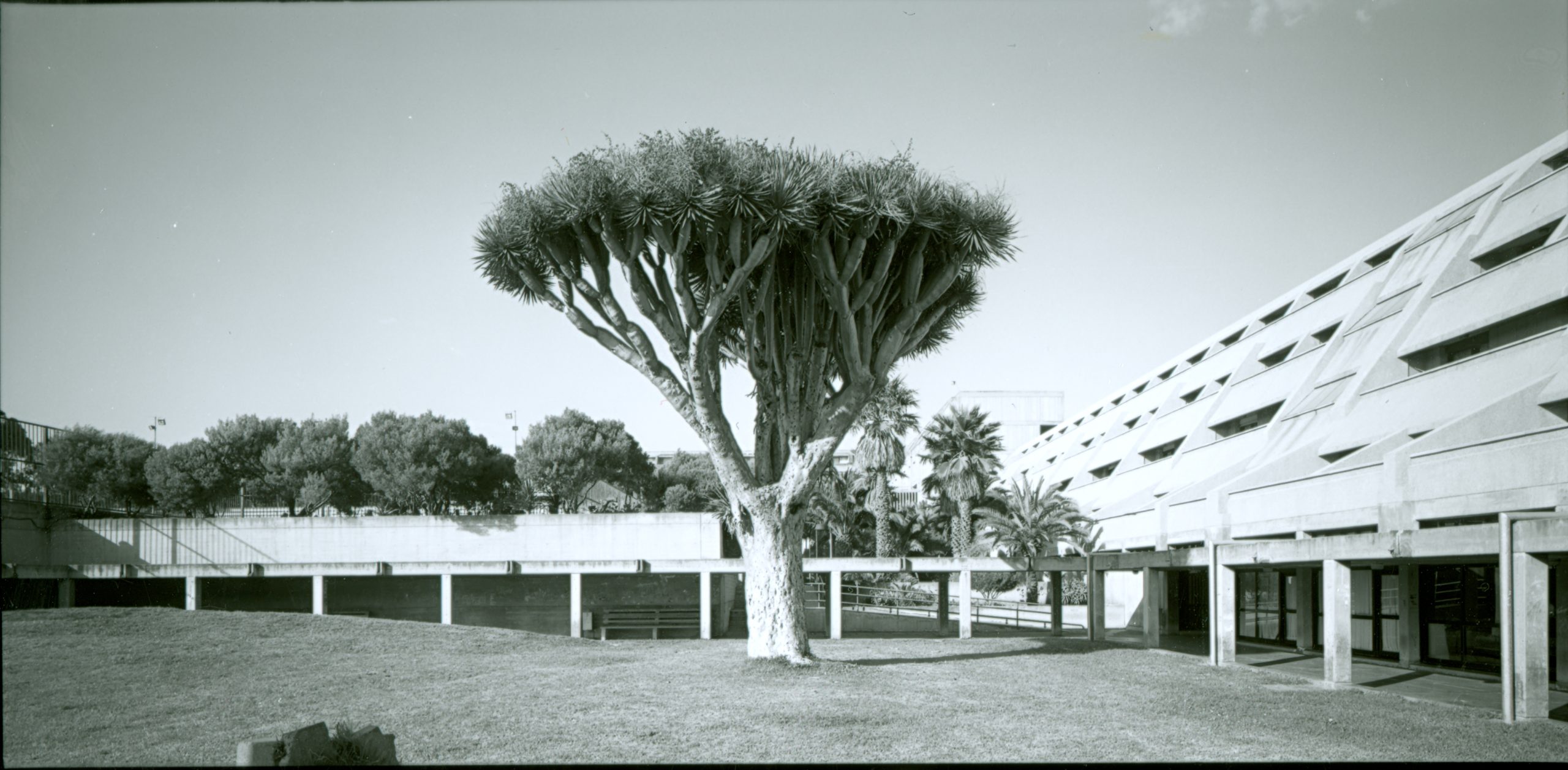


Located in the vicinity of the University of La Laguna campus, the Universidad Laboral de Tenerife (1969–1977), designed by the Tenerife-based architects Javier Díaz-Llanos and Vicente Saavedra, is a complex that integrates an educational center, a student residence, and a university dining hall.
The project, conceived to be developed in phases, is designed as an open and flexible organizational structure capable of accommodating successive extensions adapted to the demands of future growth yet to be defined.
The original core consists of two buildings arranged in an “L” shape: a representative two-story volume housing the reception hall, administrative areas, and library; and a stepped five-story volume that accommodates the dining hall, above which the rooms of the male residence unfold, featuring south-facing terraces.
Both volumes define a landscaped cloister with porticoes, which becomes the main public open space of the complex. From here, a pedestrian street departs in the form of a covered gallery, running across the entire plot from east to west. This “interior” street, responding to the humid and cool microclimate of La Laguna, organizes circulation throughout the complex and serves as the backbone of the comb-like layout that structures the ensemble. The extension of the teaching areas and the male residence is supported along this axis, as well as the new female residence, whose own cloister will complete the intervention at the highest end of the site.
The complex, entirely built in concrete, makes systematic use of prefabricated modular elements, turning the façade into the expression of a process guided by constructive logic. Supported by exposed concrete edge beams, prefabricated U-shaped panels of thirty and sixty centimeters in width are arranged in an apparently random alternation, forming a serial composition in which openings are freely positioned according to interior requirements.
The project promotes the integration of the arts into architecture through dialogue with two significant sculptural ensembles conceived for each cloister. The art collection associated with the complex also includes murals, tapestries, and graphic works by prominent international artists.
The Universidad Laboral de Tenerife is a benchmark of architectural modernity in the Canary Islands, a “building of buildings” that reproduces within itself the hierarchy of urban open spaces. Through an exercise in abstraction, it constructs the idea of university space as an interior urban landscape—a stepped topography suspended above a gallery-street between two modern cloisters.