
Workshops
Internationaler design workshop Wildnis Lieberoser Heide





Department of Design, Building Theory and Spatial Design, BTU Cottbus-Senftenberg,
Director: Prof. Raimund Fein, 17-21 June 2019.
Team: Juan Antonio González Pérez & Constanze Sixt con Ipek Aydin, Seyyid Cinar, Jule Günther, Jakob Pflug, Lucas Weis
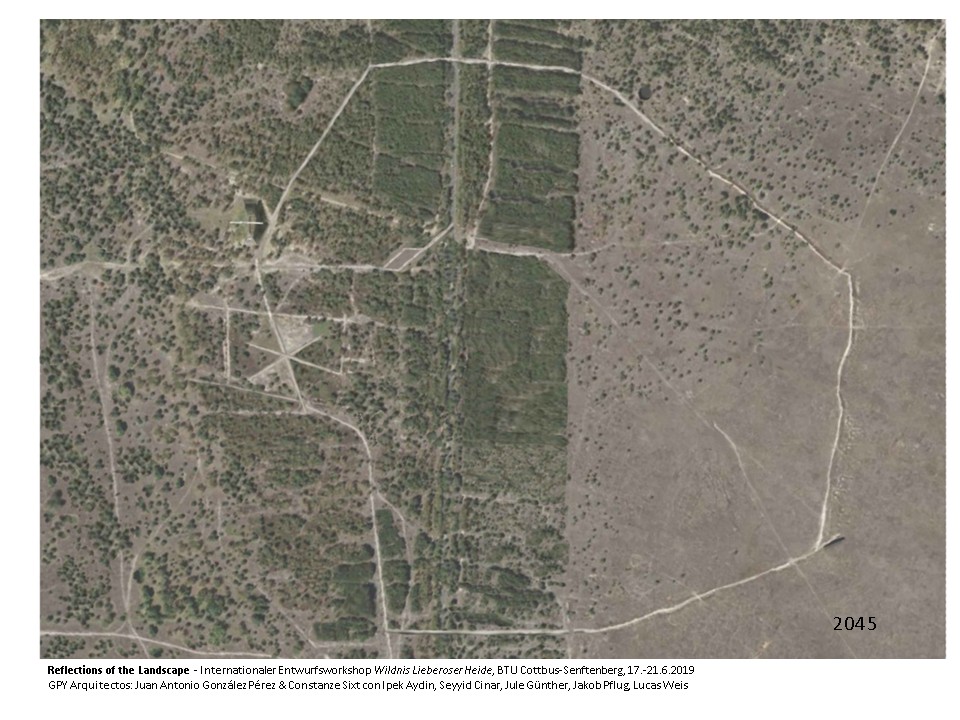
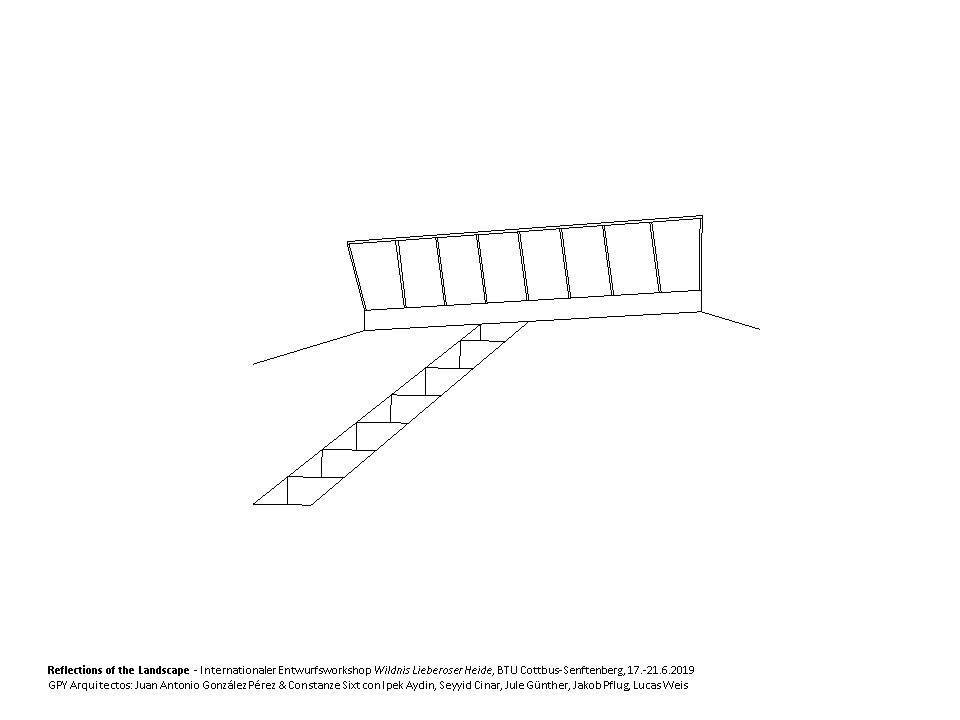
Brief: The topic of the workshop is the design of an architectural installation intended to showcase the unique nature of Lieberoser Heide and enhance its prestige.
Lieberoser Heide is an area approximately 30 km long and 15 km wide, located 90 km southeast of Berlin and 20 km north of Cottbus. From 1942 to 1945, this area was used as a military training ground for the Waffen-SS, and from 1945 until 1992 it served as a training area for the Soviet Army. After the withdrawal of the Red Army, a vast natural space remained in the heart of Europe, still bearing many traces of military use but untouched by further human intervention. The presence of unexploded ordnance means that access is only possible in certain sub-areas, which at the same time ensures tranquility/privacy and acts as an effective “protection” against the influence of civilization.
The particular conditions of this area—its size, its current inactivity, and its relative inaccessibility—have allowed a natural environment to emerge in which flora and fauna have remained undisturbed for three decades, developing their own dynamics in reclaiming a landscape once damaged by military use. Lieberoser Heide is therefore one of the largest wilderness areas in Central Europe. Within the protected area, various types of biotopes can be found, including steppe and heath landscapes, wetlands, forests, and even desert-like areas resulting from military use. The flora is rich in unusual forms and develops naturally and diversely. The fauna has established extensive protected habitats under ideal conditions, fostering species such as wolves and elk. The terrain is gently undulating, without major differences in elevation.
Significant efforts are being made to interpret and utilize this publicly owned natural space in ways that raise awareness of its uniqueness without interfering with its natural processes. A central area along the only road crossing the site—known in recent years as the “Succession Park”—provides information and views of the natural processes taking place. However, this arrangement remains somewhat improvised, and its impressive theoretical and practical potential has yet to be fully realized.
The task of the workshop is to design an architectural installation within a selected area that enables an intense experience of the freely evolving natural environment, doing justice to the uniqueness of Lieberoser Heide. The installation should also carefully address the historical significance and memory of the site as a former military training ground during World War II and the Cold War. Only by understanding the history of a place can its ongoing transformation processes be properly interpreted and evaluated. Within the planning area, additional remnants from the Soviet era—such as an observation post and a helipad—may serve as starting points.