
Conceptos
Generating and Expanding Synergies





Team: Raimund Fein, Juan Antonio González, Andrezej Gwizdala, Galit Rolbin, Constanze Sixt, Urbano Yane
This is an innovative urban concept for the Weissenhof, which reinterprets the historic estate and its surroundings as a laboratory for innovation, experimentation, and creativity. The concept provides the basis for transforming the settlement from a mere monument of the past into a vibrant and livable exhibition and working environment in which residents and students alike assume an active role as co-creators of their surroundings. In order to reactivate the area and increase public interest, the project proposes solutions addressing the existing functional and physical fragmentation of the site, establishing conceptual, functional, architectural, and urban relationships by generating multiple connections within a coherent spatial system and creating unity in diversity.
The design reinterprets the modernist idea of the functional “white cube” above ground and contrasts it with a “white void,” a cavity beneath the surface – the visitor center. Targeted interventions within the settlement highlight the existing architecture and transform open areas into integrative public spaces. All interventions provide interconnected, multifunctional spaces on several levels for activities during and after IBA’27 (International Building Exhibition), acting as a supportive framework for the World Heritage buildings of the Weissenhof Estate and their buffer zone.
WE Lab: New Visitor and Information Center – Weissenhof Laboratory
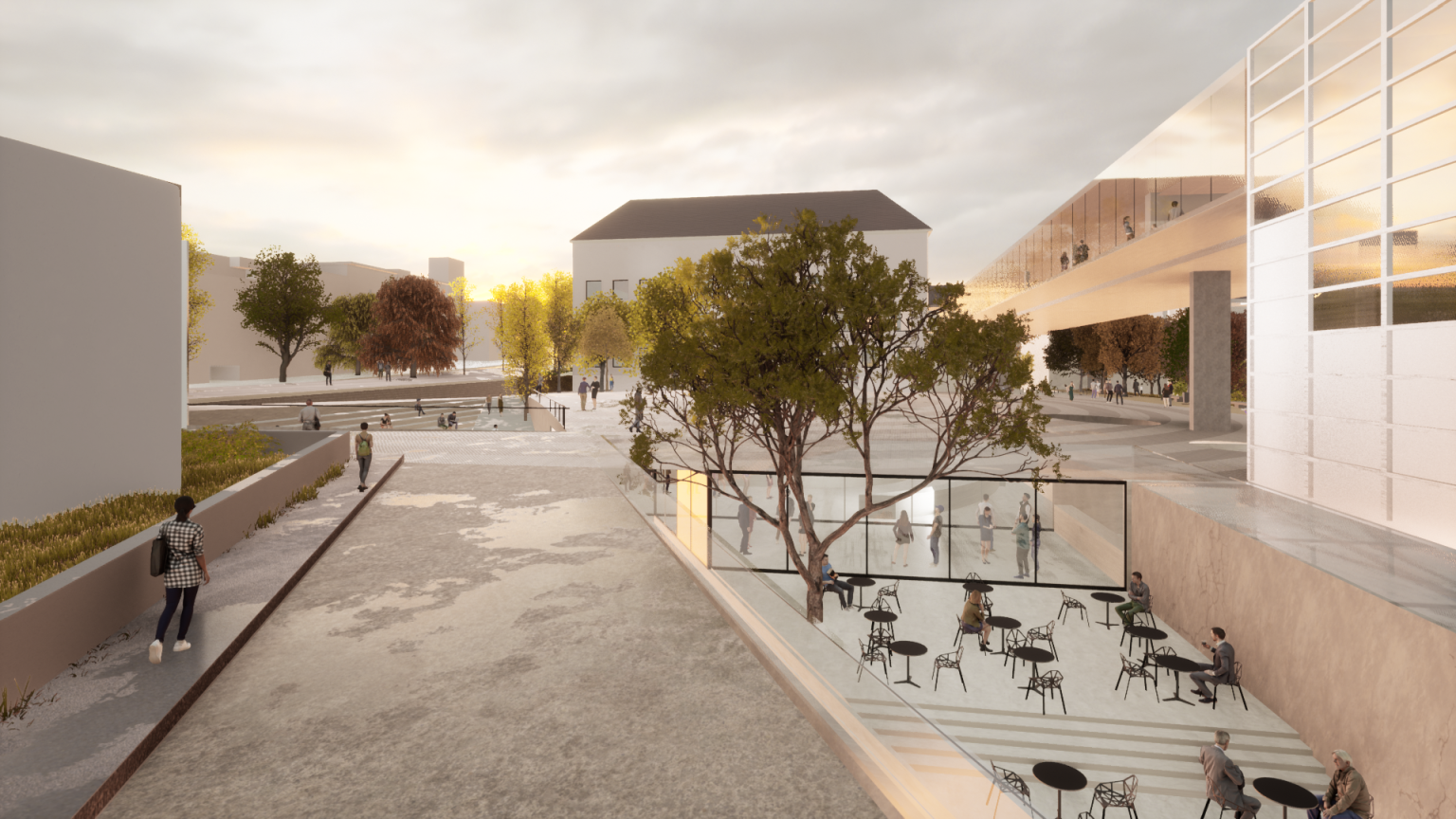
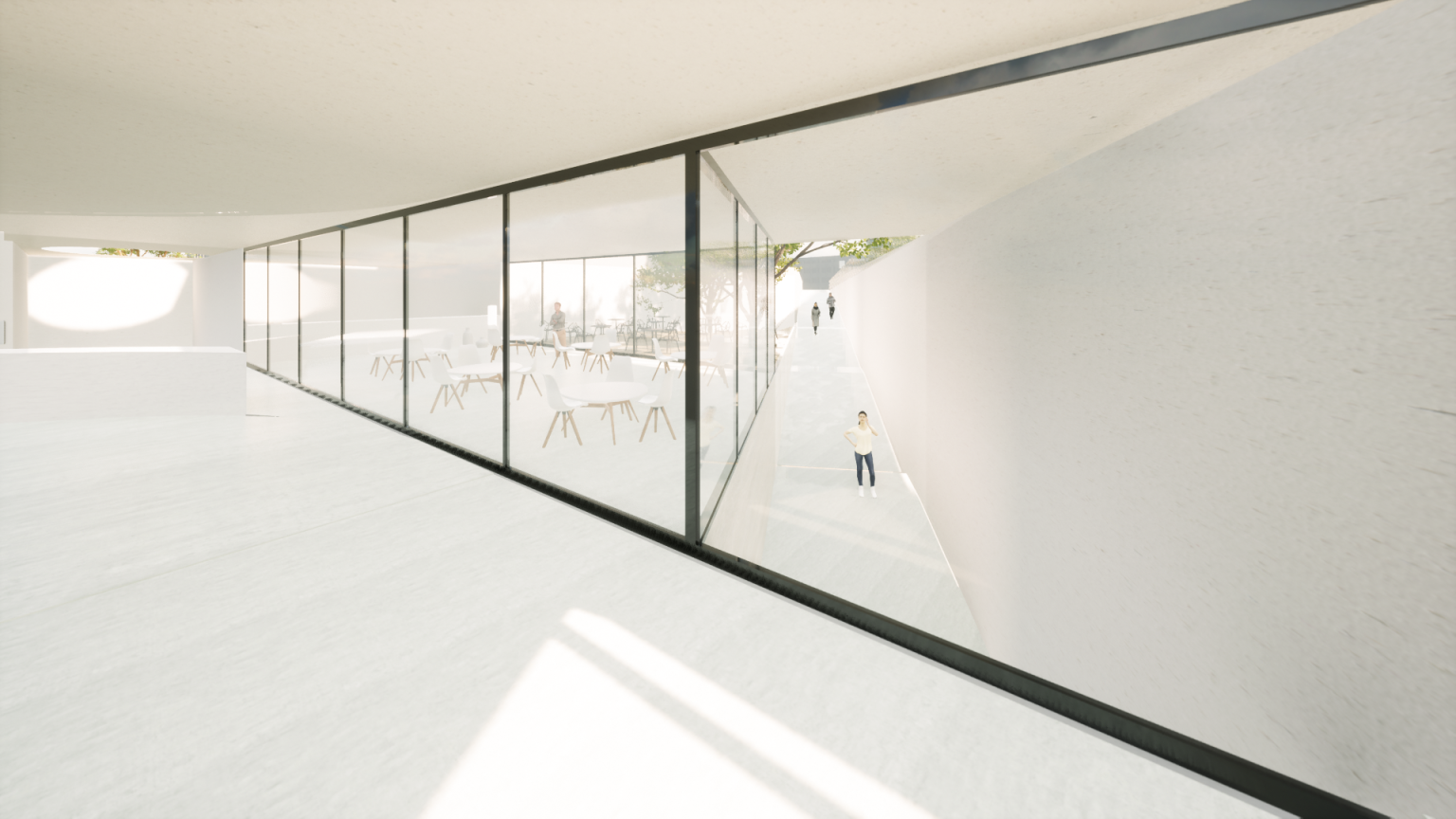
The new visitor and information center WE Lab is conceived as an innovative reinterpretation and contrast to the modernist concept of the “white cube,” namely as a “white void” that takes the form of a cavity beneath Weissenhofplatz, creating a functional space below street level.
The new center provides a new public access both to the Weissenhof Estate and to the Academy of Fine Arts. It presents itself as an urban square, Weissenhofplatz, as a central meeting point. Conceived as the starting point and extension of the exhibition route through the estate, the building leads visitors almost imperceptibly from the square to an underground level, immersing them in an interior landscape. On the site, formerly used as a quarry, the intervention does not destroy the original terrain but merely removes the fill material added after demolition. The project dematerializes and transforms the modernist “white cube.” Instead of creating a new volume, it creates a new topography in which the void becomes a fundamental component. The new space thus represents and interprets the essence of the Weissenhof Estate without competing with it.
Although located below street level, the visitor center is a light-filled space establishing visual and physical connections with its surroundings. It is conceived as an open space, a covered exterior environment that accommodates exhibition areas, visitor services, as well as administrative and event spaces for the Friends of the Weissenhof Estate, the Weissenhof Museum, and the Architecture Gallery at Weissenhof. The central space, conceived as an activity zone for workshops, performances, and events, is accessed via a generous exhibition ramp leading from the entrance foyer to the main level. This level aligns with the existing gallery in the basement of Building 2, enabling the integration of a new exhibition gallery conceived as an extension and as a link between the center and the State Academy of Fine Arts (ABK), thereby strengthening synergies between the institutions.
As visitors move through the visitor center – the “white void” – they undergo both a physical and mental process of preparation for their subsequent visit to the Weissenhof Estate, which they access directly via a ramp leading outward from the center.
Exhibition Concept – Activating the World Heritage Site
The exhibition experience is expanded through the combination of temporary installations in the outdoor spaces of the estate with exhibition activities in the visitor center, the Academy of Arts, and the historic buildings.
The entire Weissenhof area is conceived as an exhibition landscape organized along a diagonal line following Am Weißenhof, acting as an exhibition promenade that articulates, unites, and guides visitor flows while establishing connections between the estate, the Academy, the surrounding district, and adjacent green areas such as the Gustav-Stotz Anlage and Killesberg Park. Various visitor routes are created through temporary platforms and guiding elements that connect architectural highlights and urban viewpoints.
The future visit to Weissenhof includes the visitor center with its exhibition on the history of the estate and temporary exhibitions, as well as several exhibition spaces within the historic houses themselves. These spaces function as satellites of the central exhibition. The existing structures from 1927 remain physically fixed in time but are activated through dialogue with contemporary interventions.
The IBA’27 can be understood as a celebration of architecture and living. For this occasion, several temporary structures will provide open-air meetings and performance spaces as well as visitor services. The central intervention, Mies’ Urban Stage, located on a currently used parking lot, consists of a gently sloped platform equipped with a bar and service spaces beneath a protective roof, referencing the scale of the adjacent residential building by Ludwig Mies van der Rohe. Additional interventions include the Scharoun Corner and the Le Corbusier Corner, pop-up platforms and viewpoints that offer new perspectives on the settlement and the city. All these elements are conceived as lightweight timber constructions that do not permanently affect existing infrastructure or vegetation and can be dismantled after IBA’27. The area of the central Urban Stage could later be transformed into a marketplace for weekly markets, flea markets, and other events, continuing its role as a meeting space, particularly for residents.
Campus of the Future
In the floating transparent passage (quadrangle) that connects the existing and new academy buildings and frames the continuous garden space at ground level, a reinterpretation of the idea of the campus and its urban significance becomes apparent.
The current campus consists of a collection of heterogeneous buildings and courtyards on different levels, separated by narrow paths. To provide it with a new identity, the project adopts a dual strategy: on the one hand, it creates a continuous open space at the center of the site, a tree-covered meadow that connects all academy buildings and facilitates circulation across different levels. It becomes a meeting space that merges with the urban space flowing over the roof of the visitor center into an open square in front of the academy. On the other hand, the buildings are connected by a new element hosting cross-faculty uses, seminars, and workshops. This element, designed as a floating transparent quadrangle on the upper level, provides a continuous passage linking existing faculty buildings with the planned new building (Building 3). The new building adopts the geometries of the existing structures and can be accessed both from the campus and independently from the street. At the level of the quadrangle, it offers public services such as a new library and reading room, combined with a greenhouse/winter garden.
The quadrangle completes the campus by connecting heterogeneous volumes and reorganizing open spaces. It defines a contemporary cloister accommodating flexible uses and spaces for interaction and exchange. Within the campus garden it acts as a protective canopy, while toward the city it functions as a showcase revealing the creative life of workshops and exhibition corridors.
The new campus can be understood as a spatial void that reorganizes the heterogeneous faculty buildings. With its central garden, courtyards, viewpoints, terraces, greenhouse/winter garden, and green roofs, it extends across multiple levels.
Through internal connections and links to the Weissenhof Estate, it forms a capillary network extending into the city.